
Great Basin

The White Mountains
and the Age of Species
Notes from the fabled White Mountains of Eastern California and Western Nevada.
It was morning and we were somewhere just east of Mojave, on the road heading east. Soon the hot Owens Valley was laid before us and soon we were gaining elevation and into the White Mountains, on the road east of Big Pine and through desolate scrub foothills, and then through an immensity of Pinon and Juniper woodlands.
Lily was at the console, keeping the truck's engine heat between medium and high. Keeping the truck from overheating is a game on this heated incline.
We pulled air from the engine to regulate the temperature as we took on narrow and steep grades to a height somewhere above eleven thousand feet. The vegetation thinned, the skies darkened with clouds, and the gnarled high-altitude limber pines were hanging over the road. White dolomite shards covered the high slopes of these mountains, and thus, the name 'White Mountains.'
It was a J.R.R. Tolkien landscape and I remembered this passage:
"The world is gray, the mountains old, The forges fire is ashen-cold."
At the high tundra peaks, twisted pines shot up from the steep dolomite cliffs. Many of these bristlecone pines were brewing sap long before Abraham emerged from the wilderness. They are witch trees - leathered from millennia, worn, tattered and distant. They persist only here and other far reaches of the Great Basin, at the brink of death. These trees, and in particular the anonymous 4,800 year old Methuselah, may be the oldest living organisms on Earth.
"The old that is strong does not wither Deep roots are not reached by frost"
Here, on the border of Nevada and near the summit of the highest of the White Mountains and the third highest peak in California, is one of the driest regions on Earth.
It is harsh weather, especially considering that any precipitation is likely snow or ice. Deserts are defined not by heat but by a low presence of water. And so, we are standing on the western edge of the Great Basin Desert, the largest in the Western Hemisphere. These bristlecone pines survive best when devoid of moist soil, insects, or warmth. Some of the dead tree carcasses date back 10,000 years. The tree's ability to persist in such conditions is hard to grasp; the length of their lives is even more so.
Sometimes, people will say that the bristlecone pine is the oldest living organism on Earth. They are so old, that dendrologists were able to use their carbon interiors to make adjustments to our radio-carbon dating sciences.
But what really is the oldest living thing on Earth?
Lots of different people have lots of different answers for this question. It's interesting to note that a lot of these questions can be answered within a hundred miles from these White Mountains. The world's largest organism, a Giant Sequoia, lies just beyond view to the west of here. The world's tallest trees, most of them lie just northwest of here. And just southwest of here, in the heart of the Mojave Desert lies a simple bush, a creosote bush, which some people say is unquestionably the longest-living organism out there.
This plant is widespread throughout North America's desert. It is spindly and its leaves are a peculiar lime-brown. Individual plants of this species can live about two-hundred years, but the plant has a method of reproducing itself by producing new root systems and springing new plants from the same genetic material.
If this act can be measured as a single life, then the oldest Creosote Bush is almost 12,000 years old. The science to determine that, was guided by the dendrological radio-carbon technology discovered by measuring the bristlecone pine.
Twelve thousand years is old. But what about two-hundred and fifty million years? In Southeast New Mexico, scientists found bacterial microbes in a cave deep under the desert surface.
The bacteria were found in suspended animation in crystals of salt. When scientists applied nutrients to them, they revived themselves and: Boom! Two hundred and fifty million year old life.
Still, we look at the bristlecone as the oldest continuously-living single organism.
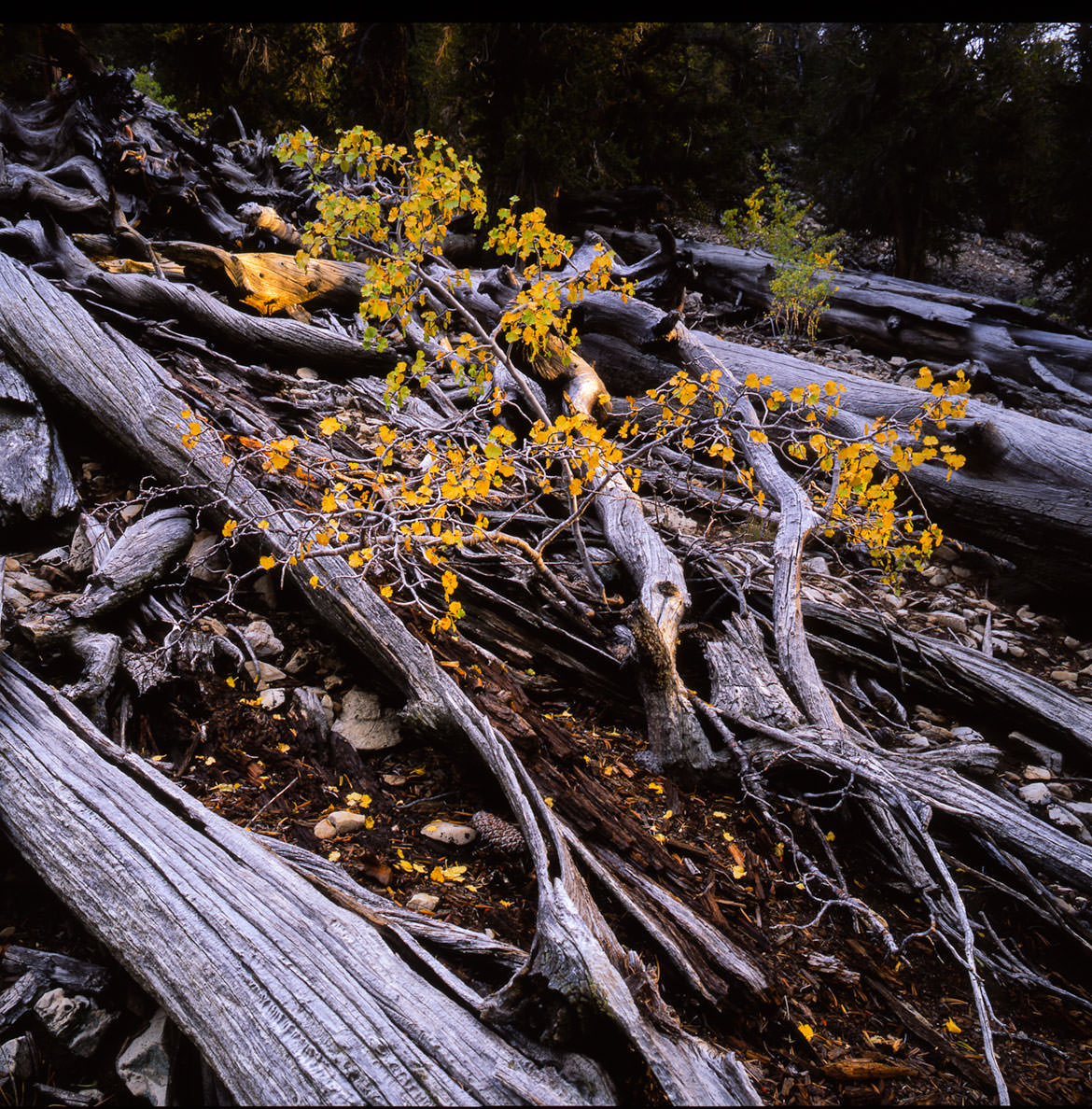
The confounding concept of time represented by the four thousand-year-old trees isn't doubled or tripled by the geology of this place, but multiplied by the thousands.
500 million years ago, this mountain was the ancient coastline of California, a coastline from a time when Dinosaurs roamed to the east, and the unimaginable ancestors of modern sharks preyed the low waters below. By the accidents of geologic history, this land has remained relatively unchanged.
Today,
its peaks are rounded, its ridges dulled and its forms subdued. It is
altogether an unspectacular sight from afar. As we near the end of the
'American Century', a vast network of changes are before us, a transformation.
To comprehend the speed of the change, it is humbling to stand here in
a range of infinite oldness and history. It is perspective beyond compare.
Looking down into the Owens Valley, I see the layout of a very familiar story to the people of Central California. Dry lakes, empty dustbowls. Once this land was green and filled with lakes. Big lakes, small lakes and in between lakes. It is an ecosystem that has been devastated in a matter of a century, all for the sake of Los Angeles, a desert city which made a desert out of Central California in order to build a mirage for itself; that it is, in fact, not a desert city. It began with a sip, a drink of Central California, and then in no time the lakes below went empty.
Everything below me now looks as miserable as the scrub brush of Los Angeles. For all it is worth, this is a transformation that has just begun. To people who have lived for centuries in the desert, the Berbers, the Mongolians the desert is clean and graceful, to be respected for its life-bringing. In new desert cultures, there is no sense of respect, from the wasteland we call Texas to the coastal chaparral of Los Angeles, people moved here out of want and ambition, not for climate or landscape. Los Angeles has always been an ugly place. Long before smog, Los Angeles still yielded no true blue sky. The mix of inland dust settling in the valleys, the dying brown of the hills, the sick Grey of the sky, and the sun shining through. All of these from natural origin.
No doubt then, that people who moved here were those who had no concept of nature; it was separate, to be conquered and avoided. The children, too, of Southland settlers are prone to this idea of Earth. Born unto a land of endless highway and street-corners and city blocks, the young Angeleno is suppressed by squares and rectangles. He is, like no generation before him, a product of a world completely ignorant of open spaces. He is brought into a world that urges him to be sedentary, for whom nothing is habitual than to switch on a television and live vicariously through the lives of the sports figures he once craved to be. For him, the city blocks are his entire future, so how can he have perspective?

A
city without perspective is a threat, for its people were born unto order,
a sense that must produce an overabundance of left-brain confinement and
an absence of imagination.
Is it no wonder that Los Angeles, a coastal city, lives as though its ocean is just a painting - with no relationship to the Pacific, the source of its primary economic influx? A week before we left for the White Mountains, I interviewed John Wood, a creation scientist, about his views on ecological issues. I wanted to understand the mindset of those who rejected evolution, and therefore the wildly successful study of biology, and everything that I saw here with my own two eyes.
He told me that he was, "distinctly suspicious of the so-called environmentalist movement because of their anti-free-enterprise orientation and because of their proliferation of unsound scare tactics." I told him that environmentalism had little to do with scare tactics; "Earth-day is monkey ecology, and so is Greenpeace. Do not defer to the fringe to make your arguments. They are not the core, they did not sit 365 days of the year in a small post in Antarctica collecting data."
I told him there was "evidence to suggest that evolutionary lineages are being broken at in a way that may impair your ability to drive to church on sunday mornings or even make god doubt your respect for his work." I told him that evolutionists didn't see a conflict with creationism because the two looked at very separate areas, but when he responded with talk of the communists and the tree-huggers, I responded by mentioning the word 'monkey' as much as possible and gave up trying to learn anything more. He said I was mean-spirited and hateful. I said that real scientists face criticism every day. "The search for truth demands doubt, and how can you make conclusions before drawing reasonable hypotheses?" I had confirmed stereotypes. Creation scientists had nothing to say of value, but their influence on the sedants of Los Angeles was huge.
After all, in the Southwest we are prone to elect our religious - and often protestant fundamentalist creationists, to office, and after so many city blocks and strip malls, is it not easy to accept his pseudo-science?
We parked in a small lot at the edge of a vast bristlecone forest, and began the hike up along a narrow path cut into the steep dolomite grades. At the ridgeline, we could see hundreds of miles - first the Saline Valley, and beyond that, Death Valley.

At dusk I made my way down a steep grade to catch a glimpse of some of the more spectacular bristlecones. Each step took several seconds; the shards of white rocks twinkled down a thousand feet. One slip and I was gone. There was nothing to hold on too, nothing to catch me. Passing clouds obscured my view, and all that was left was whiteness. I stood there in the freezing clouds for some time, unable to get any perspective on where I was.
I waited the clouds out until they passed, and then continued to descend. A shadow seemed to pass over the land, 3 gray hawks sailed below and for just a moment, I wondered why the hell we were here. After the sun went, we drove into the pinon and juniper range to set camp and fire quesadillas. In the morning, we stood up to clouds an hour before sunrise. Our clothes were damp with melting frost. Who could sleep? And so we fired the Jeep engine.
On the way, a bobcat dodged ahead. I walked up the stiff cliffsides of the Schulman Grove, and witnessed the entire southern Sierra range - from the giant Mountains of Yosemite to the Eastern Sequoia. All of it was bathed in the purple of dawn. Below, a vein of smog rested on the Owens Valley floor. This was not Oakland smog or Los Angeles smog, but Asian smog that took only days to make its way here.
Soon,
we were walking along the 'Methuselah Trail', a four-mile path through
the densest groves. We looked for ocean fossils along the way, perhaps
a trilobite, or even the ancient remains of Mr. John Wood's relatives.
By noon, we were on the roads through Mojave and headed toward 'Ranch
99', a supermarket on the border of Compton and Carson. 'Ranch 99' is
a giant Chinese market in South Central Los Angeles. Most everyone there
is Asian, and so is the food. Live catfish and dungeness crabs, durian
and hog's feet. Mangoes for twenty-six cents each and 14 brands of soy
sauce.
Everything is fresh, clean and cheap. The facades, ugly, harsh and barren like the communities it surrounds. This place is a testament to Los Angeles and the future; that culture is dynamic, it changes and pulsates new life. It also hints at the future of America, and how we are becoming a compendium of international ideas - a global culture. Los Angeles' trend is being followed from Des Moines to St. Louis to Tucson. It is a wonderful and frightening transformation; a new world where choices abound, ideas mix, where citizens of each city may have little in common with their fellow citizens; but are somehow more a part of a greater global community. Lonely people in an efficient, cold world.
This place is an affront to composition, to ordinary respect which mankind should give himself. This is out of reach of the Angeleno, who knows not aestheticism from a tract-home. Aesthetics is at the heart of environmentalism, it is the parallel which is often put aside by the larger issues of resource scarcity and bioecological threats. Aesthetics is not rooted in tradition or culture, it is as dynamic a concept as the cultures, which promote or deny it. It is the subtle difference between class and trash, leather and rubber, wood and aluminum siding. It is everything that Los Angeles is not. This place is, in the words of Robert Kaplan, the "aesthetic abyss."